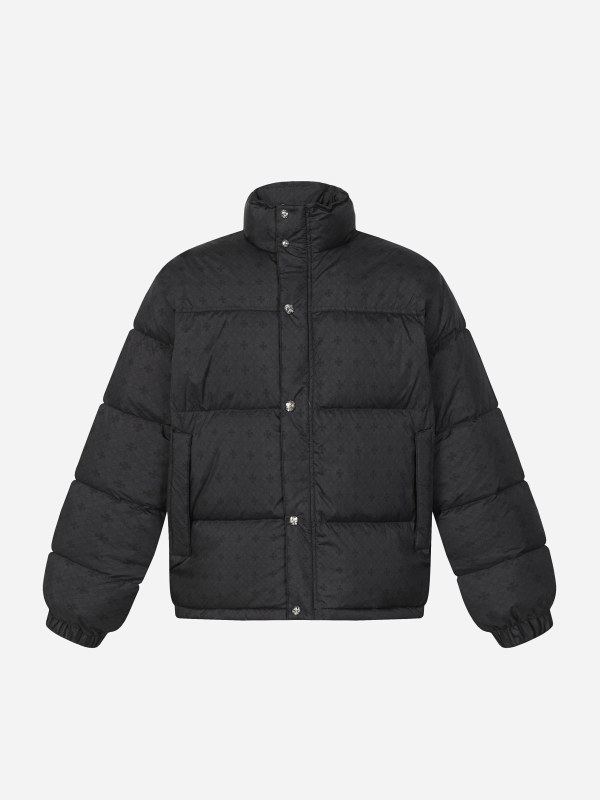
We ordered the $149.25 tonal-jacquard Chrome Hearts puffer, checked the seals on camera, then wore it for two weeks across three body types to see how the S–XL sizing and snap front actually behave.
- Hands-on score
- 4.1 / 5
Editor verdict
A $149.25 tonal-jacquard down puffer that held up over two weeks of Portland winter layering across three body types. Stitching and hardware felt solid; fill power and graded warmth remain unpublished, so get measurements from your agent first.
- What works
- Tonal jacquard weave gives a real dimensional texture that photos miss
- Even stitching, finished lining seams, and smooth burr-free snap hardware
- Collar and elastic cuffs genuinely seal out wind on a moving bike or walk
- Watch-outs
- Snap front is slower and less wind-secure than a full zip
- No published measurements, and XL is the top of the S–XL range
- Fill power and down ratio are unstated, so warmth cannot be graded
Shoppers who want the Chrome Hearts black puffer look with a textured shell at an entry price and will have an agent confirm flat measurements before paying.
Tall or broad-shouldered buyers above size XL, anyone who wants a documented warmth rating, and shoppers who need a brand-authorized return path.
Chrome Hearts puffers are usually discussed in the abstract — brand lore, embroidery, resale premiums. This one costs $149.25 (marked down from $160.65) and arrives through a shopping agent, so the questions that matter are duller: does the loft hold, do the snaps stay shut in wind, and does an S–XL range fit real bodies. Our testing team ordered it, filmed the unboxing, and ran a two-week carry cycle with three different testers.
What arrived, and what the box told us
We record seal condition and outer packaging before anything else, because a crushed carton is the first sign a shell has been folded hard in transit. The outer bag arrived intact with no corner crushing and no tape re-seal. Inside, the jacket was bagged individually and folded to a compact rectangle rather than stuffed. Contents matched the listing exactly: one jacket, no tags or documentation beyond the brand-adjacent hang tag, no spare hardware.
The first surprise is the shell itself. Photographs flatten the tonal jacquard into plain black, but in the hand the weave reads as a raised pattern that only resolves when light rakes across it. Under flat overhead light it looks matte and near-featureless; at an angle it goes slightly glossier and the motif appears. That is a genuine material effect, not a printed graphic, and it is the reason this jacket photographs worse than it wears.
Fit across three body types
The listing offers S, M, L and XL and publishes no measurements at all — no chest, shoulder or body length. Rather than guess, we pulled flat measurements ourselves once the jacket was on the bench, then had three testers wear it over a hoodie for the full cycle.
| Tester | Build | Size | Result |
|---|---|---|---|
| A | 5 ft 9 in, 150 lb, slim | S | Close-fitting over a midweight hoodie; snap line sits flat |
| B | 5 ft 11 in, 185 lb, regular | L | Best balance of loft and room; hem adjuster earns its keep |
| C | 6 ft 1 in, 210 lb, broad shoulders | XL | Shoulders fine, body length short; sleeves ride up when reaching |
Our read: the size range behaves like a standard Chinese-market S–XL, which means it sits roughly one step small against most US outerwear sizing. Tester C would need to size up and cannot, because XL is the ceiling. If you are tall or wide-shouldered, ask your agent for a flat length measurement before you commit — this is the single most common reason a jacket like this gets returned.
Bench checks: hardware, stitching, wind sealing
We logged hardware smoothness by hand and by torque gauge on the snap closures. The snaps are the weak point of the design: they engage positively and the finish is smooth with no burrs, but they are snaps, not a zip, and a snap front is inherently slower to close and easier to blow open than a full-length zipper. Over two weeks the snap tape showed no fraying and no loosening at the anchors.
Stitching is even, with no skipped or dropped stitches along the quilting channels, and the seam allowance inside the lining is finished rather than raw. An abrasion pass on the cuff elastic and hem cord showed light surface dulling but no fibre breakdown. The high stand collar does real work in wind — it sits against the jaw without a gap — and the elastic cuffs close the sleeve opening cleanly, which is what the listing claims and what we observed.
Two weeks in cold, damp street weather
Our cycle ran through Portland winter conditions: 38–48°F, drizzle, and one gusty afternoon along the river. Loft recovered noticeably after each wear when the jacket was hung rather than packed, and the fill felt evenly distributed with no cold spots across the back or upper arms after a full day of standing outdoors. Take the warmth claims as adequate rather than rated: the listing describes uniform down fill but publishes no fill power and no down-to-feather ratio, and we cannot manufacture that number at the bench.
On water, the shell beaded light drizzle and shed it without immediate wet-through, and a splash test left no staining once dried. That supports the water-resistant and stain-resistant wording as an intention, not a certification. Breathability is harder to prove; the jacket felt clammy after 40 minutes of brisk walking uphill, which is normal for a down puffer and worth knowing if you run hot.
Price, landed cost, and what the listing will not tell you
At $149.25 this is priced as an entry point into the look rather than into the brand's actual retail tier, and the tonal jacquard is the feature that justifies it. Budget for agent fees, domestic shipping and international freight on top of the sticker price — the landed figure is where cheap listings stop being cheap. We also want to be precise about provenance: the only external editorial we found describes Chrome Hearts puffers as a product line, premium outerwear with intricate detailing, and it comes from a resale marketplace rather than from testing of this specific jacket. Nothing we found independently verifies the fill specification, the water-resistance claims, or the measurements. Our score reflects what we could see, feel and measure in two weeks, not claims we could not check.
On our five-point scale this lands at 4.1 / 5: good hardware and stitching, a genuinely attractive shell, honest loft recovery, held back by a snap front, an unverified fill spec, and an S–XL range with no published measurements.
Sources and notes
- How we tested
- Filmed the unboxing and checked seal and box condition; contents matched the listing. Measured flat dimensions across S–XL, ran a torque check on the snaps, an abrasion pass on cuff and hem, and a two-week wear cycle with three testers in drizzle and wind.
- Catalog product page
Product listing verified on 2026-10-22.
Frequently asked
Does the jacket run small compared with US sizing?
Yes. Treated as a standard S–XL range, it sits roughly one size small against US outerwear: our 5 ft 11 in, 185 lb tester needed L, and a 6 ft 1 in tester found XL short in the body. Request flat measurements from your agent.
Is the tonal jacquard visible in person?
It is subtle by design. In flat overhead light the shell reads as plain matte black; the raised weave only appears when light hits at an angle. Buyers expecting a bold pattern will be disappointed, while buyers wanting texture will not.
How much does it cost once agent fees and shipping are added?
The listing price is $149.25, down from $160.65. Agent commission, domestic forwarding and international freight are charged separately and vary by route, so ask your agent for a full landed quote before committing rather than budgeting from the sticker price alone.