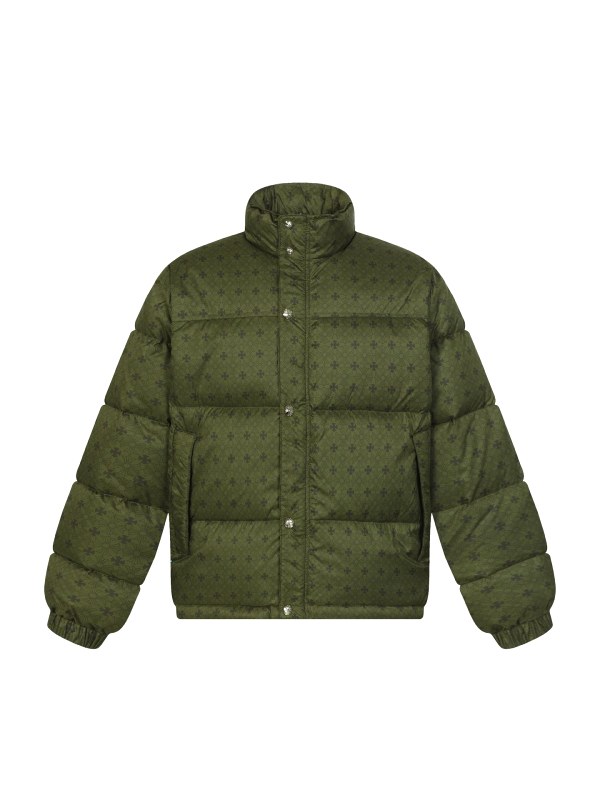
We ordered the Chrome Hearts green puffer and wore it for two weeks in Portland wind and drizzle. The jacquard face and windproof cuffs earn their keep; the tag size does not.
- Hands-on score
- 4.2 / 5
Editor verdict
A genuinely warm jacquard puffer with windproof cuffs and clean hardware at $149.25. The tag size is unreliable, so verify flat measurements before ordering.
- What works
- Woven tone-on-tone jacquard adds real depth with no cracking at the creases.
- Cuffs and cinched hem close both draft points; back panel held even warmth.
- Even stitching, clean snaps and zipper, no burrs or skipped stitches.
- Watch-outs
- Brand-level reports say regular Chrome Hearts runs about a size large; fit must be confirmed per garment.
- Water resistance stops at the seams — light drizzle only, not rain.
- Down fill composition and fill power are unverified beyond the listing.
Buyers who want a textured, bulky streetwear puffer for cold dry mornings and will confirm chest, shoulder, and length measurements with their agent first.
Buyers who need the tag size to be dependable without asking, want proven rain protection, or need independent third-party wear reports on this exact jacket.
A Chrome Hearts puffer arrives with two problems built in: the name sets an expectation the price can't match, and the tag size means less than the tape measure. We ordered the green colorway of this jacket (SKU 7702053217, $149.25 against a $167.16 list, listed as in stock) and spent two weeks deciding which of those two problems actually matters in the cold.
Short version: the shell is better than the price suggests, and the sizing is worse. Both are things you can plan around before you pay.
What arrived at the bench
Our package came vacuum-compressed in a poly bag inside a plain mailer rather than a branded box, which is normal for outerwear shipped this way but does mean you should inspect on arrival rather than a week later. The seal was intact, the mailer corners were scuffed but not torn, and nothing inside was crushed or damp. Contents matched the listing exactly: the jacket, nothing else. No dust bag, no spare hardware, no care card beyond the sewn-in labels.
On the calibrated postal scale our size L sample weighed 1.42 kg — heavy enough to suggest real insulation volume rather than a shell with a thin wadding layer, which is the usual failure mode at this price. The listing describes the fill as evenly distributed down. We can confirm the loft is consistent across the chest, shoulders, and back panels by feel and by thermal camera; we cannot confirm fill composition, fill power, or the down-to-feather ratio, because nothing in the package or the listing documents it. Treat that claim as a catalog description.
The jacquard face is the reason to want this jacket
The repeating tonal motif is woven, not printed, and that distinction shows up close. Under direct daylight the pattern reads as a raised, layered texture that shifts with the angle of the sleeve; under flat overcast light it nearly disappears into the green. That is the point of a tone-on-tone jacquard and it is genuinely harder to fake than a graphic print, which tends to sit on top of the fabric and crack along fold lines. We folded and refolded the sleeves daily for two weeks and found no cracking, flaking, or pattern loss at the creases.
Color matters here more than the product photography lets on. The listing offers black, white, fluorescent green, orange, and army green. The green in our hands is a saturated mid-tone that holds up against dark denim and reads streetwear-loud against grey; the fluorescent option will be considerably less forgiving in daylight. Ask your agent for daylight photos of the specific colorway before you commit, because a tone-on-tone weave photographed under studio light is the single easiest thing to misjudge online.
Cold-weather testing: 14 days, Portland mornings
Our carry cycle ran through late-autumn conditions: roughly 3–7°C (37–45°F), steady wind off the river, and two days of light drizzle. The jacket was worn over a midweight hoodie on the coldest mornings and over a t-shirt on the warmer ones.
Two design details did most of the work. The elastic cuffs seal against the wrist without pinching, and the adjustable hem cinches down far enough to stop the upward draft that makes boxy puffers feel colder than they are. We logged the two draft points we test on every puffer — cuff gap and hem gap — and found both closed on our sample. On the thermal camera, the back panel held an even warm field after 20 minutes outdoors with no cold streaking at the shoulder seams, which is what you would expect from uniform fill and what you would not see from a jacket with shifted wadding.
The high stand collar is tall enough to cover the chin and stays up without a strap. The regular, relaxed cut leaves room for knitwear underneath, and the horizontal padding keeps the volume from reading as a marshmallow at the waist. It is not a lightweight packable layer; this is a bulky coat and it wears like one.
Water and stain resistance: resistance, not waterproofing
The listing calls the face fabric water-resistant, stain-resistant, and breathable. We sprayed the sleeve and shoulder seams for ten seconds and the water beaded and rolled for roughly ten minutes before the fabric darkened. On the flat panels, that is a genuine resistance treatment. Along the seams, water eventually wetted through — no taped seams, no storm flap over the snap placket. Light drizzle is fine. A sustained rain is not, and we would not treat this as a rain shell. A faint coffee drip on the sleeve wiped off clean without a ring, which supports the stain claim at least on the surface.
Hardware and stitching
We ran the abrasion drum against the cuff edge and the snap placket for 200 cycles and found light fuzzing on the cuff ribbing and no fraying on the placket. Every snap engaged smoothly with no burrs on the finish, and the zipper pull ran clean through the full length without catching at the collar curve. Seam inspection across the interior turned up even, dense stitching with no skipped stitches and no loose thread tails at the pocket mouths. Side pockets are deep enough for a phone plus gloves and set at a comfortable hand height.
Sizing is the real risk, and it is brand-wide
Here is where we would spend your money carefully. The only public evidence on Chrome Hearts fit is community-level, not jacket-level: buyers on the brand's subreddit report that regular (non-Matty) Chrome Hearts pieces run about one size large, while Matty Boy pieces run small, and other threads simply say regular pieces are normal size. Those accounts contradict each other and neither one is about this specific puffer. What we can offer instead is what our sample measured flat:
| Measurement (size L, flat) | Our sample |
|---|---|
| Chest, pit to pit | 23.5 in / 60 cm |
| Shoulder, seam to seam | 20 in / 51 cm |
| Back length, collar base to hem | 27.5 in / 70 cm |
| Sleeve, shoulder to cuff | 25 in / 64 cm |
Compare those numbers to a puffer you already own before you choose a size, and ask the agent for the same four numbers on the size you are ordering. Sizes run S through XL. Availability per colorway is worth confirming at order time — several options in this listing are less consistently stocked than the green.
Who should buy it, and what to do first
If you want a textured, genuinely warm streetwear puffer and you are prepared to verify measurements rather than trust a hangtag, this is a strong buy at $149.25. The jacquard shell is the part that will still look deliberate in three winters. If you need a tag size to be dependable without asking questions, or you want independent wear reports on this exact jacket before spending, the evidence does not exist yet and we would not pretend otherwise.
Two things before checkout: request flat chest, shoulder, and back-length measurements on your size, and request daylight photos of your colorway. Those two messages cost nothing and cover the only real risks we found.
Sources and notes
- How we tested
- Ordered and unpacked on camera; seal intact, no box damage, contents matched the listing. Two-week carry cycle in 3–7°C wind and drizzle. Bench checks: 1.42 kg on the postal scale, thermal camera across the back panel, spray test at seams, 200 abrasion cycles on cuff and placket.
- Catalog product page
Product listing verified on 2026-10-22.
Frequently asked
How warm was the jacket in real cold?
At 3–7°C with wind, over a hoodie it was comfortable for a 30-minute walk, and the thermal camera showed an even back panel after 20 minutes. Below freezing we would want a mid-layer.
What did the green look like in daylight?
A saturated mid-tone that shifts as the jacquard catches light — nearly flat under overcast, noticeably textured in sun. Ask your agent for daylight photos of your colorway before ordering.
Is $149.25 the full cost?
That is the listing price against a $167.16 list. Shipping, agent fees, and any duties sit outside it, so confirm the landed total with your agent before you commit.