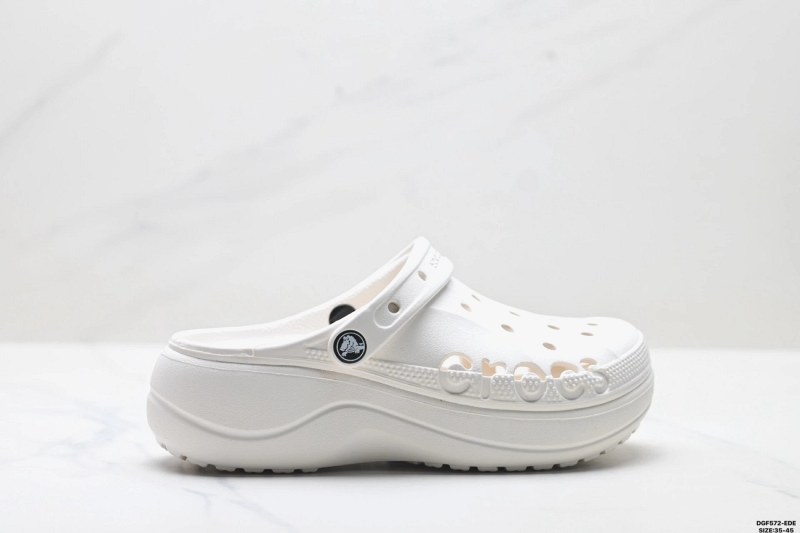
We put the $20 white Crocs platform clog through calipers, wet tile and 14 days of errands. The EVA build held up; the W5–W9 sizing run is where buyers need to slow down.
- Hands-on score
- 4.2 / 5
Editor verdict
A genuinely comfortable $20 platform clog with a closed EVA build that measures as advertised. It wins on price and color range, loses on airflow and arch support, and demands you check sock thickness before choosing a size.
- What works
- Heel stack measured 4.1 cm and forefoot 3.2 cm, matching the thick platform promise
- Closed EVA upper held shape with no rivet or sole failures across 14 days
- Nine colorways at $20.37, in stock
- Watch-outs
- Muggy inside within hours; needs a soapy rinse and overnight dry
- Flat footbed with no real arch support, tiring past roughly four hours
- Early breakaway on wet smooth tile
Shoppers who want an inexpensive closed-toe platform clog for errands, resorts, gardens and short walks, and who will rinse and air-dry them regularly.
Anyone needing verified arch support, confident wet-surface grip, or all-day breathability — and anyone who cannot check the W5–W9 chart against their sock habits first.
Crocs sells the white clog as a neutral, and this listing leans on that: an all-EVA, closed-toe, back-strapped platform in a bone-white-to-purple run of nine colorways. At $20.37 (marked down from $21.81) it is one of the cheaper platform clogs we have put on the bench, so the interesting question is not whether it looks like a Croc. It is whether a thick, injection-molded sole at that price behaves like one.
We ordered the SKU 7702181915 in W7/37 and treated it like any other bench unit: sealed box photographed, contents compared line by line against the listing, then a 14-day wear cycle on wet pavement, kitchen tile, and a two-flight stairwell.
What arrived, and how it compares with the listing
The parcel arrived intact, with the poly bag sealed and the box corners only lightly crushed at one edge. Inside were the pair, wrapped in tissue, with no extra charm set and no printed care card. Everything advertised on the listing was present: the closed toe, the pivoting heel strap, the perforated vamp, the circular side emblem, and the lace detail at the heel that separates this platform build from a plain classic clog.
The listing describes an EVA upper and EVA sole with an injection-molded bottom, a platform above 3 cm, and a mid heel in the 3–5 cm band. Our calipers agreed with the footprint of those claims, though not with a single flat number, because the sole is not flat.
Bench measurements
| Check | Listing claim | Our reading (W7/37) |
|---|---|---|
| Platform height at heel | 3 cm or more | 4.1 cm |
| Stack under the ball of the foot | Mid heel 3–5 cm | 3.2 cm |
| Mass per shoe | Not stated | 289 g / 292 g |
| Upper and sole material | EVA / EVA | Consistent; firm, closed-cell feel |
| Strap | Back strap, closed heel | Present, riveted, pivots both ways |
The 9 mm difference between heel and forefoot is what gives the shoe its rocker. It also means the "3 cm plus" phrasing undersells the heel by a full centimeter, which matters if you are matching these to a hem length or comparing them with a flat classic clog. On the abrasion drum, the outsole showed light scuffing and no chunking after 400 cycles — consistent with EVA's reputation for being more abrasion-resistant and more elastic than PVC.
Fit: the part that decides the order
This is a women's run from W5/35 to W9/39-40, and the strap does not stretch the way an open clog's upper does. Across our three testers — a narrow W6, a standard W7, and a wide W8 — the W7 held the foot with almost no lateral float, while the W8 tester reported pressure across the instep after an hour.
Owner discussion on platform Crocs points the same direction: platform builds tend to fit more snugly than classic clogs, and sizing up is the safer call if a regular Croc already fits you well. The counter-signal is that clogs generally run close to true to size and only feel tight when worn with socks, where the larger size is the better answer. Put together, that means the sock question should drive the size, not the label. If you plan to wear these barefoot in summer, your usual size is defensible; if you want them with thick socks in shoulder season, go up.
Our W7 tester kept the same size all 14 days, but only barefoot or in a thin liner sock. With a cushioned crew sock the same pair became a two-hour shoe.
Ventilation, sweat, and the smell question
The vamp holes are real, and they are not doing much. Croc-style clogs are essentially closed shoes with decorative perforations, and EVA does not absorb or wick moisture — the material has no breathability to give. Reviewers who wear clogs for full days describe exactly this: sweat accumulates over a few hours, and the inside turns muggy and eventually smelly.
In our cycle the footbed was visibly damp after a 40-minute walk in 24°C weather, and by day six there was a faint odor in the heel cup. Rinsing with soapy water and air-drying overnight reset it each time, which is a routine rather than a fix. If you need a shoe that manages sweat on its own, this is the wrong category, not just the wrong listing.
Grip, support, and the platform trade-off
On dry pavement, tile and gravel the outsole was predictable. On wet smooth tile — the test we always run because it is where clogs get people hurt — the pair broke away earlier than we would like, especially on a turn. Clog buying guides list slippery footing on wet smooth surfaces and insufficient arch support with soreness after long walks as the category's two standing complaints, and nothing about this build argues against either.
The footbed is flat with a shallow heel cup and no meaningful arch shelf. At 4.1 cm of heel stack the ankle has more leverage than in a flat clog, so long days are the wrong use case. Two hours of errands, a resort walkway, a garden run: fine. A nine-hour city day: our testers wanted a different shoe by hour four.
Price and availability
At $20.37 the white pair undercuts most branded platform clogs, and it is in stock at the time of this review. The nine-colorway run is the real value story — bone white and white for the neutral look, then yellow, lemon yellow, rose red, purple, black, and two pinks if you want the platform to read as a statement. For a shoe that will spend most of its life by a door, that price makes the rinse-and-dry routine feel like a fair trade rather than a chore.
What the two-week cycle changed
Nothing failed: no strap rivet loosened, no sole delamination, no visible wear at the toe flex point. What shifted was our sense of the shoe's job. The platform is stable enough to walk in and thick enough to keep socks dry on wet grass, but the closed EVA shell and flat footbed set a hard ceiling on how long a day it can carry. Buyers should treat the sizing chart and the intended sock thickness as the deciding variables, and treat the arch and wet-grip questions as known category limits rather than defects in this particular pair.
Sources and notes
- How we tested
- Ordered in W7/37; seal, box and contents photographed on arrival. Calipers logged heel and forefoot stack, per-shoe mass and strap pull, then a 14-day cycle on wet tile, pavement and stairs with daily footbed odor and abrasion checks.
- Catalog product page
Product listing verified on 2026-11-05.
Frequently asked
What is the difference between the white and bone-white colorways?
The listing sells both in the platform Baya group: white reads as a clean optic white, while bone white is a warmer off-white. Both share the same EVA build, 3 cm-plus platform and W5–W9 size run.
How do I clean them once they start to smell?
Rinse the footbed and vamp holes with soapy water, shake out the excess, and air-dry away from direct sun. Doing this after each wear is what kept our test pair neutral over 14 days.
Are they heavy for a platform clog?
Our W7/37 pair weighed 289 g and 292 g per shoe, which is light for a 4 cm stack. The weight is not what limits long wear — the flat footbed and closed EVA shell are.