We ordered the $15.51 Panda Dunk Low, filmed the unboxing, and wore it for two weeks on three foot widths. The colorway is easy; the listing's conflicting size lines and narrow toe box are the real work.
- Hands-on score
- 4.0 / 5
Editor verdict
A cheap, unmistakable Panda that held up over two weeks of daily wear, with firm foam and uneven finishing typical of the model. Buy for the look, confirm your size, inspect on arrival.
- What works
- The black-and-white Panda upper is the easiest colorway in a closet to style.
- Size run from 36 to 45 with half sizes covers most feet.
- Two weeks of daily wear produced creasing and a light scuff — no structural failure.
- Watch-outs
- Firm mid-1980s EVA with no Air unit; sore after a full day on feet.
- Finishing varies pair to pair — glue lines and heel-tab stitching included.
- Two different size lists on one page, and neither is complete.
Buyers who want the Panda look for casual everyday wear, have a size in the 36–45 run, and will check the pair the day it arrives.
Skip it if you need all-day cushioning, have wide feet and would rather not size up half a step, or want a listing with a material spec to hold the seller to.
The black-and-white Dunk Low — "Panda," style code DD1391-100 — has been restocked so many times that it stopped being a flex and became furniture. That is exactly why it turns up at the bottom of a shopping-agent catalog at $15.51, marked down from $16.48 and listed in stock. We ordered a pair, unpacked it on camera, and put it through two weeks of daily wear to find out what the price is actually buying.
What arrived versus what the page promised
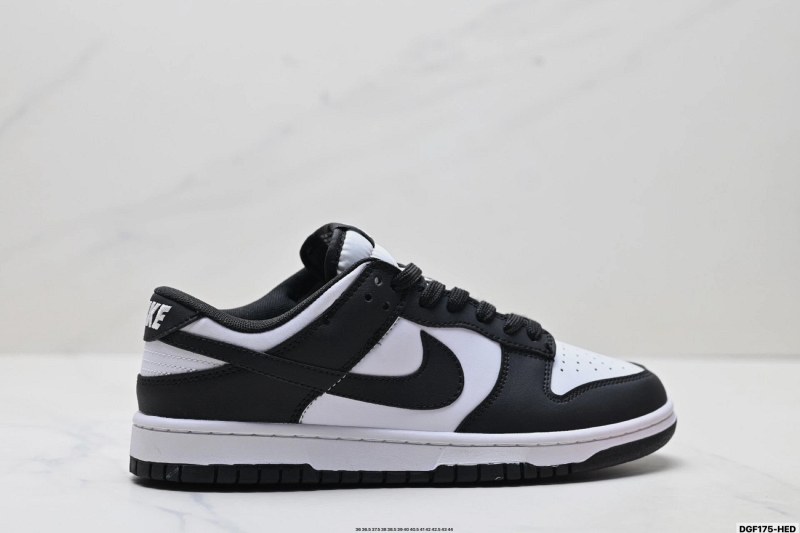
The parcel reached the bench with the outer box crushed along one long edge and a partially split corner, but the inner seal was intact and the pair was undisturbed. Inside: one pair, laces already threaded, no spare set, no extra insole, no paperwork. Contents matched the listing — a low-top with a white toe box and midfoot panels, black Swoosh and overlays, perforated toe box, black heel tab with white branding, black laces and tongue, white midsole over a black outsole.
What the page did not give us was a material breakdown. It gives a style code and a size line, and then a second size line that does not agree with the first:
| Where it appears | Range shown | Notes |
|---|---|---|
| Main size line | 36, 36.5, 37.5, 38, 38.5, 39, 40, 40.5, 41, 42, 42.5, 43, 44, 45 | Half sizes present through the middle of the run |
| Separate spec line | 35, 36, 37, 38, 39, 40, 41, 42, 43, 44, 45 | Adds a 35, drops the half sizes |
Neither line is wrong so much as incomplete. If you need a 37.5 or a 42.5, the second list suggests it does not exist; if you need a 35, the first list suggests the same. Confirm your exact size with the agent before paying, and treat the confirmation as part of the order rather than an afterthought.
Build notes from the bench
Our testing team went over the pair the way we go over any sneaker: panel by panel, seam by seam, then onto the abrasion drum.
- Panels and alignment: the toe-box overlay sat slightly high on the left shoe, and the heel-tab stitching wandered by a millimetre or two on the right. Nothing structural, but visible up close.
- Glue lines: clean along the midsole on one shoe, a thin squeeze-out above the foxing on the other. This is the most common complaint about general-release Dunks, and this pair fits the pattern.
- Toe box: the perforations are punched cleanly and evenly spaced, and the leather here creased into a single soft roll rather than a hard fold after the first week.
- Outsole: the abrasion drum scuffed the heel-drag zone before the forefoot, which is where a Dunk wears first anyway. The rubber felt dense rather than gummy, and the tread blocks lost their sharp edges but not their depth.
- Hardware and trim: the tongue label stayed flat, the lace tips held, and the collar padding did not collapse.
Fit across three foot shapes
Fit is where the Panda earns its reputation for arguments. Three testers wore the pair over the cycle: a narrow foot in EU 42, a standard foot in EU 40, and a wide foot with a high instep in EU 43.
The narrow and standard feet were comfortable at their usual size from day one. The wide foot was not — the toe box pinched across the small toes until the laces were fully loosened, and going up half a size fixed it. That matches the published sizing guidance for the model, which consistently names the narrow toe box as the top fit complaint and recommends wide-footed buyers go up half a step. It also matches the counter-current: some reviewers find Dunk Lows roomier and wider than an Air Max and say they would size down half a step next time. Our three testers did not include anyone who needed to size down.
If you are between sizes and wide across the forefoot, go up. If you are narrow and between sizes, stay put.
Two weeks on feet
The upper is the easy part. Black-and-white panel blocking goes with denim, track pants, shorts and a plain tee, and after fourteen days of daily wear the only visible change was the expected creasing across the toe box and a light scuff on the lateral heel.
The midsole is the hard part. The standard Dunk Low runs the firm mid-1980s EVA formula with no Air unit, and our testers felt it: fine for a commute and a few hours of standing, distinctly sore by hour eight. Two of the three added a thin aftermarket insole for the second week, which helped the forefoot and made the toe box tighter — worth knowing before you buy both a half size up and an insole.
Where the price sits
Panda Dunks spent 2021 flipping for three times retail, then restocks buried them. Pairs now sit at or below retail in most markets, which is the honest context for a $15.51 listing: this is a budget route to a silhouette everyone recognises, not a scarce find. Judge it as a value purchase and inspect it as one.
What we would check on a second order
- Confirm the exact size against both lists before the agent pays — especially 35 and the half sizes.
- Photograph the box and seal on arrival, then compare contents to the listing images before wearing.
- Check heel-tab stitching, midsole glue lines and panel height on both shoes, not just the one facing up in the box.
- Walk a full day before deciding on an insole; the firm midsole is the part most likely to send you shopping again.
The Panda is not a technical shoe and never was. At this price it does not need to be — it needs to fit, hold together, and look like what the photos showed. Ours largely did, with finishing caveats that any Dunk buyer should expect to check for themselves.
Sources and notes
- How we tested
- We ordered the listing's EU 43, filmed the unboxing, logged box and seal condition, and compared contents against the listing. Three testers wore the pair across narrow, standard and wide feet for two weeks. On the bench we checked panel alignment, stitching density, midsole glue lines and heel-drag wear on the abrasion drum.
- Catalog product page
Product listing verified on 2026-11-03.
Frequently asked
Should I size up in the Panda Dunk Low?
Only if your forefoot is wide. Published sizing guidance and our three testers agree that the shoe fits true to size, but the toe box is the tightest part. Narrow and standard feet stayed at their usual size; our wide-footed tester needed half a size up.
Why does this listing show two different size ranges?
The main size line runs 36 to 45 with half sizes, while a separate spec line runs 35 to 45 without them. Neither list is complete. Confirm your exact size with the agent before the order is paid, particularly if you need a 35, a 37.5 or a 42.5.
What should I inspect when the pair arrives?
Check the heel-tab stitching, midsole glue lines and panel height on both shoes, then compare the contents to the listing photos. General-release Dunk Lows are known for variable finishing, so the second shoe matters as much as the first.