## The Specific Decision This Post Addresses: goyard Bags, Split vs. Combined Shipping This post aims to resolve a specific question: when you're about to purchase one or more goyard bags and using fashion-reps to view products and purchase options, should you split them into multiple packages or wait and combine them into one shipment? After reading, you should be able to do three things: record the actual information for each item and package; separately verify the billing conditions for split
The Specific Decision This Post Addresses: goyard Bags, Split vs. Combined Shipping
This post aims to resolve a specific question: when you're about to purchase one or more goyard bags and using fashion-reps to view products and purchase options, should you split them into multiple packages or wait and combine them into one shipment?
After reading, you should be able to do three things: record the actual information for each item and package; separately verify the billing conditions for split and combined shipping; and pause any savings judgment when evidence is insufficient, rather than choosing a method based solely on item count or experience.
This content does not apply to orders that already have complete warehouse weighing, packaging dimensions, route quotes, and destination country tax/duty results. For such orders, refer to the order page, warehouse page, and carrier quotes. 📦

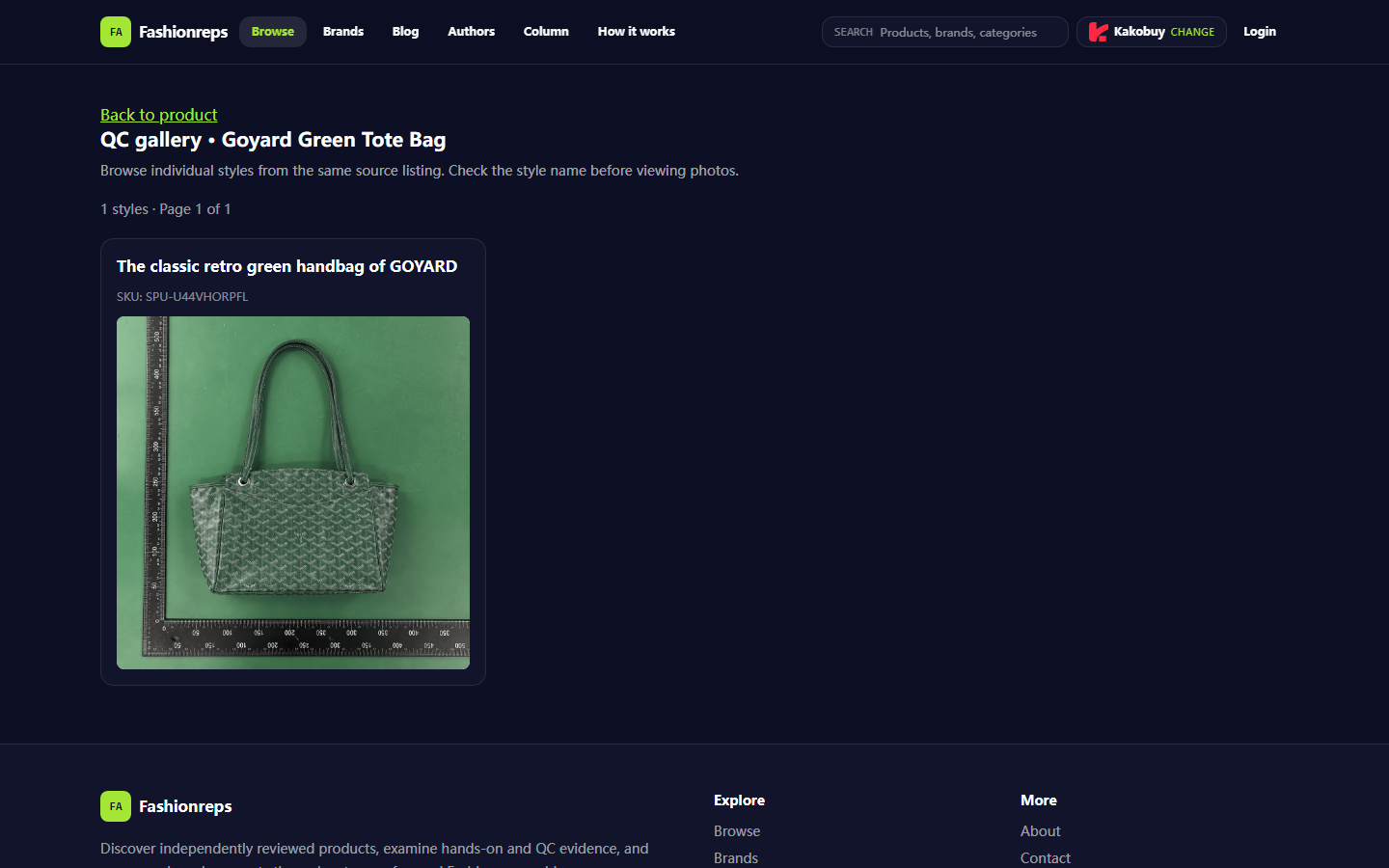
Image: Example of a Goyard bag QC page on the Fashionreps product page. The image is used to illustrate where to view product and QC information, and does not imply that this article has completed physical inspection or shipping tests.
First Confirm the Items, Quantity, Destination, and Currently Visible Packaging Conditions
Before comparing split and combined shipping, record the following information in your order notes:
- Product name, style, and quantity
- Product price and currency shown on the product page
- The shopping agent platform selected at purchase
- Destination country or region, and specific postal code or regional restrictions
- Whether the items have arrived at the warehouse
- Whether warehouse photos or QC photos are available for each item
- Whether individual weight, package dimensions, packaging method, or special packaging restrictions are currently displayed
- Service fees, packaging fees, international shipping fees, and any other potential charges shown on the page
- Date of verification of fee information
The materials provided currently only include a summary of the Fashionreps product page and the QC page entry, without providing the current product price, inventory, actual warehouse weight, packaging dimensions, destination, route quotes, exchange rates, or tax data for this goyard bag. Therefore, this article cannot confirm whether splitting is cheaper or combining is cheaper.
Fashionreps page states that the product page is for discovering products, viewing QC information, and entering an external purchase process through the selected shopping agent. Orders, payments, and shipping are handled by the shopping agent website. Specific fees must be verified by going back to the selected agent and destination pages. 🔎
What Item and Package Fields Need to Be Recorded for the Split Option
Split shipping means arranging items into two or more separate packages. It may reduce the declared value or weight of each individual package, or allow each package to fit different routes; at the same time, split shipping often incurs duplicate fixed fees and increases the number of packages and the possibility of separate loss, delay, or exceptions.
For each split package, at least record:
- Package number
- Items included and quantity
- Item value and currency
- Actual weight after packaging
- Length, width, height after packaging
- How chargeable weight is calculated
- Selected shipping route and service type
- International shipping fee
- Packaging or reinforcement fees
- Service or handling fees
- Taxes or customs clearance fees that may apply in the destination country
- Tracking number and status
- Time of quote and status verification
Do not compare only item counts. For example, two bags split into two packages may each trigger a first weight or minimum billing; if the route charges by volumetric weight, the external packaging dimensions of the bags may also change the result. Without these fields, you cannot calculate a reliable total cost.
How to Verify Volume, Chargeable Weight, and Packaging Restrictions for the Combine Option
Combining means putting multiple items that have already arrived at the warehouse into one package and shipping them together. It may reduce duplicate first weight, duplicate handling, or separate processing fees, but it may also increase volumetric weight due to a larger outer box, or trigger route restrictions on package value, dimensions, item type, or quantity.
Before combining, confirm with the warehouse or shopping agent:
- Estimated length, width, height after combining
- Actual weight after combining
- Chargeable weight after combining
- Whether original packaging, shoeboxes, fillers, or other protective materials will be removed
- Whether removing packaging will affect product protection or after-sales evidence
- Whether there are package size or weight limits
- Whether there are single shipment value, item quantity, or route restrictions
- Combining service fee and repackaging fee
- Whether re-weighing or re-quoting is required after combining
- How liability is divided in case of damage, missing parts, or external packaging abnormalities
If combining compresses or removes protective materials for the bags, first confirm whether this treatment is acceptable. Saving shipping costs cannot automatically offset the risk of product deformation, scratches, moisture, or difficulty in after-sales evidence. 🧾
How to Record Product Price, Service Fee, Packaging Fee, and International Shipping Separately
Do not combine all amounts into a vague "shipping cost." It is recommended to separately record product cost, discounts, platform service, warehouse handling, packaging, and international shipping. This way you can know which item the difference comes from, and avoid mistaking coupons for combined shipping savings.
| Cost Item | Need to Record for Split | Need to Record for Combine | Basis for Verification |
|---|---|---|---|
| Product price | Price and currency of items in each package | Price and currency of all items | Product or order page |
| Product discounts | Discounts actually applied to each order or package | Whether discounts still apply after combining | Discount rules and checkout page |
| Shopping agent service fee | Fee corresponding to each order or package | Fee for combined order | Agent checkout page |
| Warehouse or packaging fee | Items billed separately for each package | Combining, reinforcement, or repackaging fees | Warehouse service page or quote |
| International shipping fee | Chargeable weight and route quote for each package | Chargeable weight and route quote after combining | Shipping quote page |
| Taxes and customs clearance fees | Verify according to package or destination rules | Verify according to combined package rules | Official destination country information and carrier instructions |
| Exchange rate impact | Actual exchange rate and time for each payment | Actual exchange rate and time at combined payment | Payment page or bill |
Total cost should be calculated separately as follows:
Split total cost = Item cost and applicable discounts + Split service fee + Packaging fees for each package + International shipping fees for each package + Applicable taxes and customs clearance fees + Exchange rate conversion impact.
Combine total cost = Item cost and applicable discounts + Combine service fee + Combine packaging fee + International shipping fee after combining + Applicable taxes and customs clearance fees + Exchange rate conversion impact.
The formulas here are just a recording method, not a quote, and cannot derive a fixed savings amount. The current materials do not provide valid values to plug in, so it cannot be claimed how much money a certain option can save. 💱
Condition Comparison Table for Both Options and Evidence Timestamps
| Condition | When to Check Split More | When to Check Combine More | Current Material Status |
|---|---|---|---|
| Whether items are individually stocked | Items arrive at warehouse at different times, or some items not yet QC'd | Items all stocked and can be weighed together | Not provided |
| Packaging dimensions | Individual packaging is compact, and splitting won't obviously trigger duplicate fixed fees | Combining can reduce duplicate external packaging volume | Not provided |
| Chargeable weight | After splitting, each package is still within acceptable chargeable range | After combining, volumetric weight does not increase significantly | Not provided |
| Route and restrictions | Some item needs a different route or has single-shipment restrictions | All items fit the same route and restrictions | Not provided |
| Risk diversification | Don't want all items in one package | Prefer to reduce package count and handling times | Needs personal preference confirmation |
| After-sales and evidence | Want to keep packaging and package records separately | Accept unified receipt and evidence after combining | Not provided |
| Taxes and customs | Destination country rules apply separately per package and can be verified | Declaration and customs rules after combining are clear | Not provided |
All highly volatile fields should note the verification date, and clearly state destination country, currency, route, and applicable conditions. Product prices, inventory, discounts, shipping fees, exchange rates, taxes, routes, and page link status may change; old screenshots cannot be directly used as current quotes.
How to Create a To-Confirm List and Stop Savings Judgment When Information Is Insufficient
If any of the following situations occur, mark the status as "To Confirm" and temporarily do not choose split or combine:
- No destination country or postal code
- No bag quantity or inbound status for each item
- No actual warehouse weight or packaging dimensions
- No route quotes for split and combine options
- Unclear whether the route uses actual weight or volumetric weight
- Unclear whether coupons can be used for multiple packages or combined orders
- Unclear whether service fees and packaging fees are charged repeatedly per package
- Unclear about destination country taxes and customs clearance rules
- Quote page cannot be opened, information is blank, or outdated
- Product and package restrictions not confirmed by agent or carrier
The to-confirm list can be written in the following format:
- To confirm: Chargeable weight after combining
- Evidence needed: Warehouse re-weighing result or checkout page screenshot
- Applicable conditions: Destination country, postal code, shipping route
- Verification date: Enter actual date of viewing
- Decision before confirmation: Do not claim combining is cheaper
Do not reduce costs by under-declaring, splitting to avoid taxes, or evading inspection. Taxes, import restrictions, and declaration requirements should be verified according to applicable destination country rules and carrier requirements. 🛃
Final Action: After Gathering Fee Evidence, Choose Split, Combine, or Hold
First confirm the style from the Fashionreps product page, then log into your actually selected shopping agent account and record the product price, service fee, warehouse status, and visible QC information. QC photos on the product page can only help you view the visible information provided on the page, and cannot replace actual warehouse weighing, packaging verification, or destination country customs judgment.
When the fields for both options are complete, compare two results:
- Estimated total cost difference
- Increased risk to reduce cost
If combining only reduces duplicate first weight or handling fees but significantly increases volumetric weight, package value, or single-loss risk, record this risk separately and do not just look at the shipping number. If splitting increases fixed costs but can solve route restrictions, weight limits, or packaging risks, splitting may be more suitable for a specific order, but still subject to actual quotes and rules.
Those suitable for combining are usually people whose items are all stocked, combined dimensions and chargeable weight have been confirmed, route restrictions are clear, and who are willing to bear the risk of centralized shipping in one package. Those suitable for splitting are usually people whose different items require different routes, have clear single-shipment restrictions, or place more emphasis on diversifying shipping risks.
If actual weight, dimensions, route quotes, destination, or tax conditions are missing, it is not recommended to ship immediately in pursuit of possible savings. The safest action at this point is to gather evidence, ask the agent for a re-quote, and choose split, combine, or hold after costs and risks can be clearly explained.
Shopping Agent Platform FAQ
1. What is the best way to locate a product I want to purchase on bbd-buy.org?
You can search using a single keyword or navigate directly to the category page, where items are also sorted by brand. More specific search phrases usually produce fewer results than broad ones, but they yield better matches. For instance, you could search for "Air Force 1 White," "sneakers," or just "Air Force 1."
2. Which platform provides the most valuable coupons according to bbd-buy.org?
Kakobuy is recommended because it currently provides a $15 discount code with no minimum spend threshold. This works well for users shipping smaller parcels. Use the promo code kakobuy888.
3. What kinds of products can I find in the bbd-buy.org spreadsheet?
The site spreadsheet covers shoes, apparel, bags, accessories, jerseys, perfumes, hats, scarves, belts, and various household lifestyle items.
4. How can I evaluate the quality of a product before purchasing on bbd-buy.org?
To judge quality, examine the QC photos rather than relying on factory images, which are often edited. Use the QC photos to verify that the product meets your particular detail requirements before you decide to buy. Also, avoid items with extremely low prices, as they generally have poor quality.
5. Why does bbd-buy.org not use Google Sheets?
Google Sheets works only for small product lists. As the product count grows, loading slows down and the system lags significantly, especially on mobile where the display is poor and searching is inconvenient. For the same product set, the website spreadsheet loads faster and offers a better visual experience.