This community-shared buyer photo shows 8 short-sleeve football jerseys laid flat. This article reviews only the colorways, patterns, collars, shoulder stripes, and logos that are directly visible in the photo, and does not make judgments about fit, sizing, fabric, or durability. ## Styles Visible in the Photo The jerseys in the photo fea
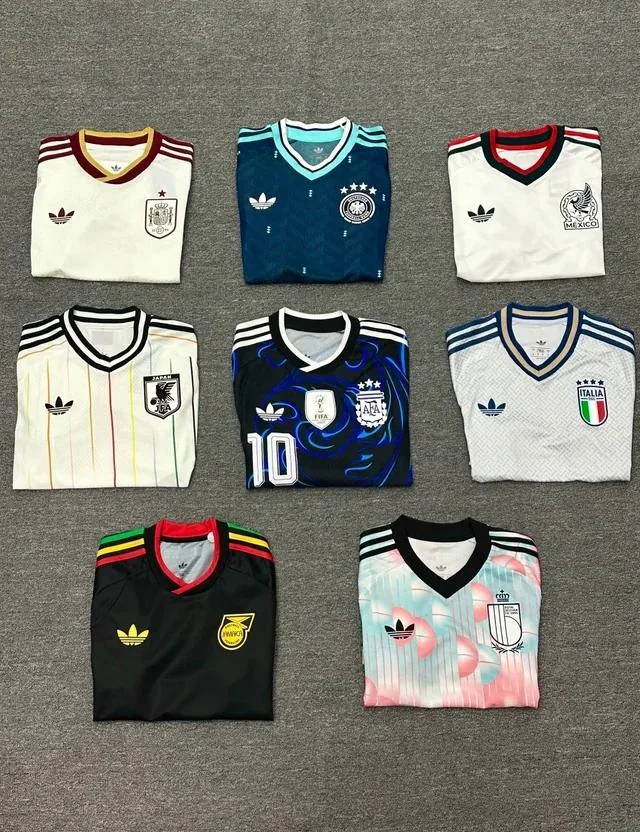
This community-shared buyer photo shows 8 short-sleeve football jerseys laid flat. This article reviews only the colorways, patterns, collars, shoulder stripes, and logos that are directly visible in the photo, and does not make judgments about fit, sizing, fabric, or durability.

Styles Visible in the Photo
The jerseys in the photo feature various national team style designs. In the top row, you can see a white jersey with red and yellow collar, a dark blue German-style jersey, and a white jersey with Mexican logos. The middle row includes a white Japan-style jersey, a blue and black patterned Argentina-style jersey, and a white and blue Italy-style jersey. The bottom row has a black jersey with red, yellow, and green details, and a pink-blue gradient patterned jersey.
Each jersey is mostly fully visible, with the team crest, chest logo, collar, and shoulder stripes all fairly clear. The visual differences between the styles are obvious, ranging from white retro looks to more striking designs like large blue and black patterns, colorful vertical stripes, and pink-blue gradients.
Appearance Detail Review
The white jerseys generally have a more classic football shirt look, with contrast colors like red-yellow, black-white, or blue-white mainly concentrated on the collar, shoulder lines, and chest area, giving a relatively clean overall appearance. The darker and patterned jerseys are more distinctive; the blue-black one has a large covered pattern area, while the black one creates strong contrast through red, yellow, and green stripes and a yellow logo.
The photo also shows that some styles use different collar structures, including V-necks, crew necks, and designs with contrasting edges. Shoulder stripes are quite prominent on multiple jerseys and are an easy detail to compare in a flat-lay state. The chest logos and team crests are generally clear, but based solely on the appearance in the image, one cannot confirm brand authenticity, specific model, or official version.
Pros and Limitations of This Photo Set
The photo is suitable for comparing the following:
- Main colors and contrast color combinations of each jersey
- Positions of team crests, chest logos, and shoulder stripes
- Collar shapes and edge colorways
- Front visual elements such as patterns, vertical stripes, and gradients
- Overall recognizability of different designs in a flat-lay state
The photo cannot confirm the following:
- Actual sizing and fit
- Fabric composition, breathability, and stretch
- Changes after washing or long-term durability
- Back prints, numbers, and back collar details
- Complete workmanship of cuffs, hem, and inner seams
- Specific model, price, and stock status of the styles shown
What to Check Before Buying
If you want to further judge whether a particular style is suitable for purchase, you should prioritize checking measured dimensions such as flat-lay full length, shoulder width, chest width, and body length, and confirm whether the product page provides fabric information, a size chart, and back photos. For cuffs, hem, and inner seams that are folded or obscured in the photo, you should also look for closer images.
Overall, this photo set is best used as a reference for style and colorway. The classic white jerseys are easier for observing logo and stripe layout, while the blue-black pattern, black contrast, and pink-blue gradient jerseys emphasize visual personality. Since all jerseys are folded and laid flat, the photo cannot replace information on sizing, material, and wearing performance.